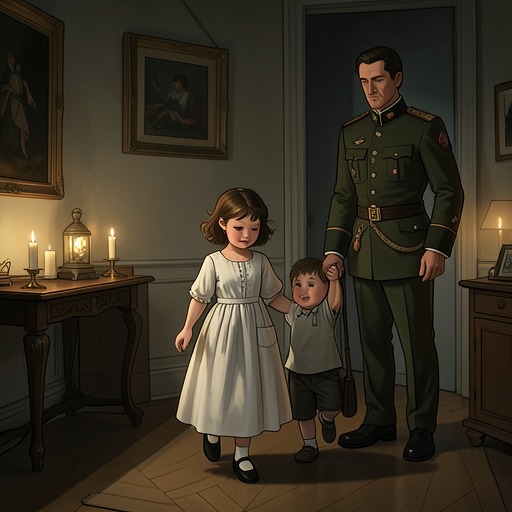
Jenny
Tinea and Leah: [Cyberpunk, Alien Incursions, Murder and Mayhem, Girl's Love (WLW)]Jenny is a six-year-old British orphan living at Saint Viktor in New Montreal. She is identified as Andi’s honorary big sister, placing her within the informal family structure the children have built among themselves. Although Jenny appears only through a hurried remote conversation, her injury and recovery give the distant orphanage an immediate physical reality and show how strongly the children remain connected to Leah while she is away.
Identity and Place in Saint Viktor
Jenny’s role is defined less by formal authority than by care among the children. As Andi’s honorary big sister, she occupies a protective position in the orphanage’s sibling-like community, alongside the adult care provided by Sister Lana. The title suggests affection and responsibility rather than biological kinship: Saint Viktor’s children create relationships that compensate for the losses and separations shaping their lives.
Jenny’s age also matters to the scene. At six, she is old enough to be recognized as responsible for a younger child such as four-year-old Andi, but young enough that a simple accident can become a major household event. Her injury does not isolate her from the group; instead, it becomes something the children collectively respond to and transform.
Injury and Recovery
During Leah’s call, the children report that Jenny broke her arm after tripping down the stairs. Sister Lana took her to the hospital, and Jenny returned the same day with her arm immobilized in a plastic cast. The account is delivered amid interruptions and childish attempts to pronounce “hospital,” making the injury feel both serious and contained within the everyday rhythms of Saint Viktor.
The cast initially appears to the children as ugly, but they collectively decorate it by writing their names across the plastic. This changes the meaning of the injury. The cast remains evidence of pain and vulnerability, yet it also becomes a shared object carrying the group’s signatures. Jenny’s recovery is therefore presented not only as medical treatment but as communal care: the children make the visible mark of her accident into a record of belonging.
Relationship with Leah and the Children
Jenny participates in the call while Leah is hundreds of miles north and moving between fights. The children urgently ask what Leah is fighting and plead for her return, while Leah reassures them that she is alive and has someone helping her. Jenny’s injury gives Leah a specific reason to respond as a caretaker rather than merely as a distant combatant; Leah asks what happened, learns that Jenny came back the same day, and tells the children to thank Sister Lana.
Jenny’s cast also reveals how the children preserve Leah’s presence when she cannot be physically with them. The children have written their names on it, and Sister Lana has written Leah’s name for her because Leah is absent. Jenny’s body thus becomes a meeting point between the orphanage and Leah’s separated life: the cast records the accident, the children’s solidarity, and Leah’s continued emotional membership in Saint Viktor.
The call further establishes the unequal emotional burden of separation. The children say that everyone is all right, but Andi keeps crying and wants Leah to come home soon. Since Jenny is Andi’s honorary big sister, her role at Saint Viktor is connected to the same caregiving structure Leah values. Jenny is not merely one child among many; she belongs to a network in which older children, younger children, and adult caretakers share responsibility for keeping one another secure.
Narrative Significance
Jenny’s scene interrupts the violence and distance surrounding Leah’s current life with a domestic report that is modest in scale but rich in consequence. A broken arm, a hospital visit, and names written on a plastic cast establish what Leah is fighting to return to: not an abstract home, but a particular community in which injuries are noticed, treated, decorated, and remembered.
Her appearance also balances the book’s repeated attention to altered bodies. Leah’s body has become radically different from the masculine body she once expected, and her combat existence increasingly moves beyond ordinary human limits. Jenny’s injured arm belongs to a contrasting register: it is a temporary childhood injury addressed through ordinary medical care and collective affection. The contrast keeps bodily vulnerability from being reduced to a symbol of weakness. Jenny’s arm hurts, receives treatment, and becomes socially meaningful without defining her entire identity.
Jenny therefore functions as a quiet anchor for the book’s ethics of care. Her injury shows the practical work of protection at Saint Viktor, while her honorary relationship with Andi shows that care is not limited to adults or biological families. Through the decorated cast and the rushed call, the narrative makes the children’s community tangible and gives Leah’s distant return a concrete emotional stake.